

Moose Math is one of the best educational games out there, designed to make learning math fun and effective for kids. If you’re looking for an app that combines great educational value with enjoyable gameplay, this one is worth checking out. Created by Duck Duck Moose, Moose Math has earned a reputation for helping young learners build essential math skills through interactive adventures.
Why Early Math Skills Matter
Early math skills are crucial for a child’s development. Studies consistently show that children who develop a strong understanding of numbers and problem-solving abilities during preschool and kindergarten tend to do better academically throughout their education. These foundational skills not only prepare kids for more advanced math but also enhance logical thinking, pattern recognition, and cognitive development—benefits that extend to all subjects.
What to Expect from This Guide
In this guide, we’ll explore whether Moose Math lives up to its reputation in 2026. We’ll cover everything you need to know about this educational app:
- How the app works
- What makes its approach to teaching math unique
- Why parents and educators continue choosing it over other options
We’ll also share insights into:
- The specific features that make learning enjoyable for children aged 3 to 7
- Practical strategies for maximizing its educational benefits
- Real feedback from parents who’ve integrated Moose Math into their children’s daily routines
Understanding Moose Math
The Moose Math app is a digital learning tool designed for children aged 3 to 7. This age group is important for developing basic math skills, as young children are most open to learning during this time. Instead of traditional teaching methods, the app provides an interactive environment where preschoolers and early elementary students can explore numbers, shapes, and basic operations through play.
Who Created Moose Math?
Duck Duck Moose, the company behind this innovative platform, has years of experience in creating educational math games for kids that combine entertainment with effective learning. They have built a reputation as a trusted name in children’s educational technology, consistently producing apps that respect young learners’ cognitive abilities while also challenging them appropriately. Their approach to Duck Duck Moose math applications focuses on user-friendly interfaces and content suitable for both kids and parents.
What Does Moose Math Aim to Teach?
The main goals of Moose Math are:
- Counting and number recognition – helping children understand numerical sequences and quantity relationships
- Addition and subtraction basics – introducing simple operations through visual and interactive methods
- Sorting and classification – developing logical thinking by organizing objects based on attributes
- Geometric understanding – familiarizing young learners with shapes and spatial relationships
- Pattern recognition – building analytical skills through identifying and predicting sequences
These learning objectives align with kindergarten-level mathematical standards, ensuring that time spent using the app contributes to school readiness. The developers designed these goals around the natural curiosity of young children, turning abstract mathematical concepts into concrete experiences. You’ll find that the app doesn’t just memorize facts—it encourages genuine mathematical thinking through exploration and discovery. The different skills being taught also support each other, creating a well-rounded early math education experience.
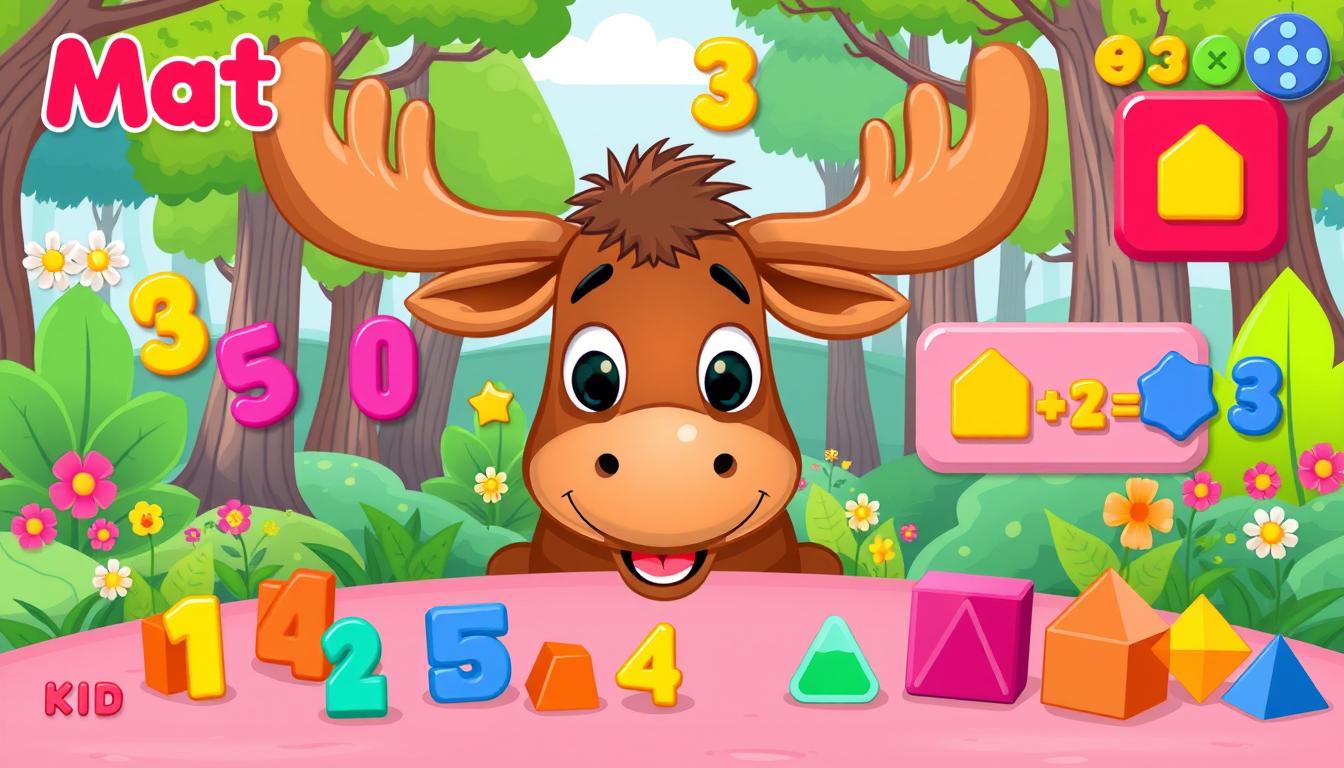
Exploring Key Features of Moose Math
Moose Math is designed to make learning math fun and exciting for young children. Instead of traditional teaching methods, the app uses an adventure theme to engage kids and encourage them to explore mathematical concepts through play.
An Invitation to Explore
When you open Moose Math, you’ll immediately notice that the interface is designed to invite exploration rather than provide direct instructions. This creates an environment where children can freely discover and learn about math while having fun.
Dynamic and Responsive Games
One of the standout features of Moose Math is its interactive games for kids. These games are unique because they respond dynamically to each child’s actions. For example:
- When a child touches a number, it bounces with personality.
- When shapes are dragged into place, they snap satisfyingly with encouraging sounds.
This immediate feedback helps children understand whether they’ve made correct choices without feeling punished for mistakes.
High-Quality Graphics That Captivate
The visual quality of Moose Math is another key feature that sets it apart. The app features high-quality graphics that create a vibrant and welcoming world for young learners. Here are some examples:
- Characters have expressive faces that react to children’s progress.
- Buildings in the virtual town light up when tasks are completed.
- Animations flow smoothly without any abrupt transitions.
The design team has made a conscious effort to avoid overwhelming young users with excessive visual elements. Instead, clean layouts are used to direct focus toward the mathematical tasks at hand.
Engaging Interaction Types
To keep children engaged, Moose Math incorporates various types of interactions:
- Drag-and-drop mechanics: These are used for sorting and organizing objects.
- Tap-based counting: This reinforces number recognition skills.
- Gesture controls: Children can use gestures to draw shapes and patterns.
- Multi-touch activities: These activities develop fine motor skills alongside math concepts.
Each interactive element in Moose Math serves two purposes: entertaining children while also reinforcing specific mathematical concepts.
Genuine Gameplay Experiences
Unlike other educational apps that may feel like digital worksheets with added graphics, Moose Math offers genuine gameplay experiences. In this app, math skills become the tools children need to progress through their adventure.
By combining engaging visuals, dynamic interactions, and meaningful gameplay, Moose Math creates an immersive learning experience where children can develop their math abilities while having a great time.
2. Adaptive Learning Challenges for Personalized Growth
Moose Math stands out among adaptive learning apps through its intelligent difficulty adjustment system. The kids math app monitors each child’s performance across various interactive games for kids, automatically calibrating challenge levels to match their developing abilities. When your child masters counting to ten, the app seamlessly introduces counting to twenty. If they struggle with a particular concept, the system provides additional practice opportunities without frustration.
This personalized approach transforms Moose Math features into a tailored learning journey. The app tracks progress through mini-games teaching counting, addition, subtraction, sorting, and geometry, creating personalized math challenges that evolve with your child’s understanding. You’ll notice the app never pushes too hard or holds back unnecessarily—it finds that sweet spot where learning feels achievable yet stimulating.
The interactive learning system recognizes patterns in how your child approaches problems. If they excel at visual sorting tasks but need more time with numerical concepts, the app adjusts accordingly. This dynamic response keeps young learners engaged because they’re neither bored by overly simple tasks nor overwhelmed by concepts beyond their current grasp.
Parents appreciate how these fun learning apps eliminate the one-size-fits-all approach. Your preschooler receives a completely different experience than your kindergartener, even within the same app. The adaptive technology ensures each child builds confidence while steadily advancing their mathematical understanding through appropriately challenging gameplay.
Educational Benefits Offered by Moose Math
Moose Math stands out in the early childhood education landscape by directly aligning with kindergarten-level common core standards. The app systematically addresses key mathematical competencies that children need to master before entering first grade. You’ll find that each mini-game within Moose Math targets specific foundational math skills outlined in the kindergarten common core standards, including number recognition, basic operations, and geometric understanding.
The structured approach ensures your child builds mathematical confidence through age-appropriate challenges that meet educatonal benchmarks. When your child plays Moose Math, they’re not just having fun—they’re developing skills that educators and curriculum designers consider essential for academic success.

Skill Development Through Engaging Gameplay Mechanics
The genius of Moose Math lies in how it transforms abstract mathematical concepts into concrete, interactive experiences. The app incorporates sorting skills for kids through colorful activities where children categorize objects by various attributes. Your child might sort fruits by color in one game, then switch to organizing shapes by their geometric properties in another.
These sorting skills for kids activities do more than teach classification—they build critical thinking abilities and logical reasoning. When your child decides whether a triangle belongs with circles or squares, they’re making analytical decisions that strengthen their cognitive development.
Pattern recognition games within Moose Math challenge children to identify sequences and predict what comes next. You’ll notice your child beginning to spot patterns in everyday life after regular engagement with these activities. The app presents patterns using colors, shapes, and numbers, allowing young learners to approach pattern recognition games from multiple angles.
The combination of sorting and pattern recognition creates a comprehensive learning experience. Your child develops spatial awareness, logical thinking, and problem-solving abilities—all while playing games featuring friendly characters and vibrant animations. These foundational math skills become second nature through repeated, enjoyable practice rather than rote memorization.
Accessibility and Availability Across Platforms
Moose Math iOS version 2026 and Moose Math Android version 2026 ensure that families can access quality math education regardless of their device preference. You can download the app from the Apple App Store for iPads and iPhones, or grab it from Google Play for Android tablets and smartphones.
This cross-platform approach to educational apps accessibility, made possible by leveraging cross-platform frameworks, removes barriers that might prevent children from benefiting from structured math learning. Parents don’t need to purchase specific devices to give their kids access to high-quality educational content. Teachers can integrate Moose Math into their classrooms whether they use iOS or Android tablets, creating consistency in learning experiences. The app maintains the same engaging features and educational value across both platforms, so your child receives identical learning opportunities regardless of which device they use at home or school.

Why Choose Moose Math Over Other Educational Apps?
When looking for the best educational apps for kids in 2026, you’ll find many options promising to teach math skills. However, Moose Math stands out with its unique adaptive difficulty system that adjusts to your child’s learning pace. Unlike other educational games that offer the same challenges to every player, this app tracks progress and automatically changes the difficulty level. This way, your child won’t feel frustrated by hard problems or bored by easy ones.
The Benefits of Story-Driven Gameplay
The story-driven gameplay creates an immersive experience that keeps young learners engaged. Many educational apps simply present math problems with colorful graphics, but Moose Math by Duck Duck Moose weaves learning into an adventure where children help characters complete missions. This narrative approach transforms practice sessions into exciting journeys rather than mundane drills.
Trustworthiness of Duck Duck Moose Brand in the EdTech Space
Duck Duck Moose reputation 2026 remains strong among trusted educational app developers for good reason. The company has spent years refining their approach to children’s educational content, consistently delivering apps that balance entertainment with genuine learning outcomes. When you choose moose math duck duck moose, you’re selecting a product from developers who understand child psychology and educational best practices.
The Duck Duck Moose apps comparison reveals a pattern of quality across their portfolio. Each application demonstrates attention to age-appropriate design, intuitive interfaces, and meaningful educational content. Their commitment extends beyond simply creating games—they focus on building tools that genuinely support early childhood development.
Moose Math represents years of expertise in creating digital learning experiences. The developers continuously update their apps based on educator feedback and current educational research. You can trust that your child is using an app designed by professionals who prioritize learning effectiveness alongside engagement. This dedication to quality education makes Duck Duck Moose a reliable choice in an oversaturated market of educational apps.
Effective Strategies to Maximize Learning with Moose Math
Using Moose Math at home requires intentional planning to extract maximum educational value. You should establish consistent daily sessions of 15-20 minutes, preferably at the same time each day to build routine. Sit alongside your child during initial sessions to understand their progress and identify areas where they excel or struggle.
For educational tools for teachers, integrate Moose Math into math centers or independent learning stations. You can assign specific mini-games that align with your current curriculum objectives. Create a tracking system where students earn physical rewards or classroom privileges for completing certain levels, bridging digital achievement with tangible recognition.
Key implementation strategies include:
- Set clear learning goals before each session rather than allowing aimless play
- Discuss what your child learned after completing activities to reinforce concepts
- Use the app’s adaptive features by allowing children to replay challenging levels for mastery
- Pair app time with hands-on activities using physical objects to mirror digital concepts
- Monitor progress reports to identify skill gaps requiring additional support
You can enhance engagement by creating friendly competitions between siblings or classmates, tracking who completes the most challenges weekly. Rotate between different mini-games to prevent monotony and ensure comprehensive skill development across all mathematical domains the app covers.
User Feedback and Reviews: What Parents Say About Moose Math in 2026?
Moose math reviews 2026 consistently highlight the app’s ability to keep young learners engaged while building essential skills. Parents appreciate how their children eagerly return to the app, viewing math practice as playtime rather than work. The user experience feedback emphasizes the intuitive interface that allows even preschoolers to navigate independently.
Educators praise the alignment with curriculum standards and the seamless difficulty progression. Some parents suggest adding more advanced content for children who quickly master the existing challenges. The reward system receives particular acclaim for motivating continued learning without creating frustration. Parents value the ad-free environment and the peace of mind it provides during screen time.
The Future Prospects: Where is Moose Math Heading?
The future of educational apps 2026 points toward enhanced personalization and AI-driven learning paths. Moose Math appears positioned to integrate advanced analytics that track individual learning patterns more precisely, offering parents detailed insights into their child’s mathematical development. Additionally, the education technology trends to watch in 2025 suggest we’ll see expanded content libraries covering pre-algebra concepts and more sophisticated problem-solving scenarios tailored for older children within the target age range.
The broader landscape of gamified learning continues reshaping early childhood education. Moose Math and similar platforms demonstrate how interactive experiences can replace traditional drill-and-practice methods with engaging narratives that maintain children’s attention while building essential skills. You can expect Duck Duck Moose to incorporate emerging technologies like voice recognition for verbal math responses and augmented reality features that bring mathematical concepts into physical spaces. The app’s adaptive difficulty system will likely become more nuanced, responding to emotional engagement indicators alongside performance metrics to create truly personalized learning journeys.
Conclusion
Moose Math is a powerful educational tool that turns early math learning into an exciting adventure for young children. The benefits of Moose Math 2026 go beyond just recognizing numbers; it also develops critical thinking skills and builds confidence in math through carefully designed gameplay. With this app, you have access to one of the most comprehensive fun learning games for kids 2026 that meets educational standards while keeping your child fully engaged.
The app’s adaptive learning system, combined with Duck Duck Moose’s proven success in educational technology, makes it a valuable investment in your child’s academic foundation. Download Moose Math today and see your child develop essential math skills through play-based learning that feels like pure entertainment rather than traditional education.
FAQs (Frequently Asked Questions)
What is Moose Math and who is it designed for?
Moose Math is an educational app developed by Duck Duck Moose, targeting children aged 3 to 7 years. It aims to teach foundational math skills through interactive and engaging gameplay.
What are the key features of Moose Math that make learning enjoyable for kids?
Moose Math offers high-quality graphics and interactive elements that create a fun learning environment. It includes mini-games teaching counting, addition, subtraction, sorting, and geometry, with adaptive learning challenges personalized to each child’s progress.
How does Moose Math support early childhood math education standards?
Moose Math aligns with Kindergarten-level Common Core Standards (CCSS) for early mathematics education. Its gameplay encourages essential skills like sorting by color and shape and pattern recognition, which are critical for young learners’ mathematical understanding.
Is Moose Math accessible on multiple platforms for easy use by parents and educators?
Yes, Moose Math is available across multiple platforms including iOS and Android devices. This accessibility benefits parents and educators by providing easy access to quality educational content anytime, anywhere.
Why should I choose Moose Math over other educational apps for kids in 2026?
Moose Math stands out due to its unique features such as adaptive difficulty levels and engaging story-driven gameplay. Developed by Duck Duck Moose, a trusted leader in EdTech known for quality children’s apps and commitment to education, it provides a reliable and effective learning tool.
How can parents and teachers maximize learning outcomes using Moose Math?
To optimize benefits for children’s math development, parents and educators are encouraged to integrate Moose Math into daily learning routines at home or in classroom settings. Consistent use combined with guidance enhances engagement and reinforces foundational math skills through fun games.
. . . . . . . . . . . . . . . . . . . . . . . . . . . . . . . . . . . . . . . . . . . . . . . . . . . . . . . . . . . . . . . . . . . . . . . . . . . . . . . . . . . . . . . . . . . . . . . . . . . . . . . . . . . . . . . . . . . . . . . . . . . . . . . . . . . . . . . . . . . . . . . . . . . . . . . . . . . . . . . . . . . . . . . . . . . . . . . . . . . . . . . . . . . . . . . . . . . . . . . . . . . . . . . . . . . . . . . . . . . . . . . . . . . . . . . . . . . . . . . . . . . . . . . . . . . . . . . . . . . . . . . . . . . . . . . . . . . . . . . . . . . . . . . . . . . . . . . . . . . . . . . . . . . . . . . . . . . . . . . . . . . . . . . . . . . . .
– – – – – – – – – – – – – – – – – – – – – – – – – – – – – – – – – – – – – – – – – – – – – – – – – – – – – – – – – – – – – – – – – – – – – – – – – – – – – – – – – – – – – – – – – – – – – – – – – – – – – – – – – – – – – – – – –